
Car window tinting
Window film is a thin layer bonded to the inside face of your glass. Fitted well it changes how much light and heat reach the cabin and how the vehicle looks. Fitted badly, or chosen badly, it bubbles, fades and has to come off again. This page covers what separates those two outcomes.
What the job involves
Film is cut to the shape of each window, then applied to the inside surface. Curved glass has to be shaped to fit, because a flat sheet will not lie down on a curved surface without being worked first. The glass is cleaned thoroughly beforehand, since anything trapped underneath stays visible for the life of the film.
After fitting, a layer of moisture remains between the film and the glass. It clears as the film cures. During that period small hazy patches are normal and are not a fault. How long it takes depends on the film and the weather, which is why the curing advice should come from whoever fitted it rather than from a web page.
Which windows are treated
Front side windows, rear side windows, the rear window and the top strip of the windshield are handled separately. Colorado treats them differently too, so the scope of the job is both a practical decision and a legal one.
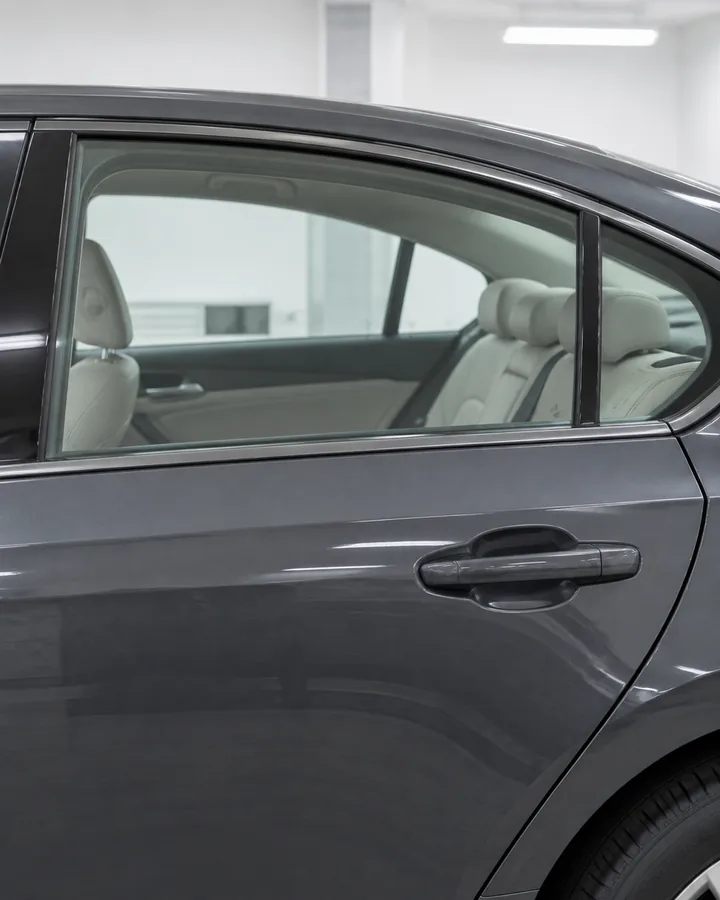
Illustrative image, not a photograph of our work.
The four film families
Almost every automotive film on the market sits in one of these groups. They differ in what they are made from, which drives both how they perform and how they age.
| Film type | How it works | Typical strengths | Known limitations |
|---|---|---|---|
| Dyed | A dyed layer absorbs light passing through it. | The least expensive way to darken glass and reduce glare. | The dye degrades under sustained sun. Fading toward purple and bubbling are the usual end state. Heat rejection is modest. |
| Metallised | Microscopic metal particles reflect energy away from the glass. | Strong heat rejection and a durable structure. | Carries a reputation for interfering with signals. More importantly in this state, Colorado prohibits a metallic or mirrored appearance on any window. |
| Carbon | Carbon particles absorb infrared energy without using metal. | Holds colour far better than dyed film and does not block signals. | Costs more than dyed film. Heat performance sits below ceramic. |
| Ceramic | Non conductive ceramic particles reject infrared while passing visible light. | The most heat rejection available at a given darkness, and stable colour. | The most expensive group by a clear margin. |
These are general characteristics of each material family, not claims about a specific product. Performance figures vary between manufacturers and between products within one range. Ask for the actual specification sheet for whichever film you are considering.
Match the film to the problem
Most disappointment with window film comes from solving the wrong problem. Work from what is actually bothering you.
| If your priority is | Then the deciding factor is | And darkness is |
|---|---|---|
| A cooler cabin in summer | Infrared rejection, which is a property of the material rather than the shade. | Largely beside the point. A light ceramic film can outperform a dark dyed one. |
| Glare on the drive home | Visible light transmittance, within the legal limit for that window. | Directly relevant, and capped by law on the front windows. |
| Privacy for the back seats | The Colorado exception for windows behind the driver. | Can go dark, but only if the windshield and front sides stay at 70 percent or above. |
| Appearance | Colour stability over time, so the car still looks right in three years. | Your choice, inside the limits. |
| Lowest price today | Material cost. | Worth knowing that dyed film is the group most likely to need replacing soonest. |
The legal ceiling on darkness
Colorado fixes the darkest legal result before taste enters the conversation, so it is worth settling first.
Read the statute in full- Windows other than the windshield
- At least 27 percent light transmittance.
- Windshield
- At least 70 percent light transmittance, with a non transparent strip permitted across the top, extending no more than four inches down.
- The trade behind the driver
- Rear side windows and the rear window may go darker than 27 percent, but only when the windshield and front side windows both stay at 70 percent or above.
Colorado Revised Statutes section 42-4-227. Installing tint that does not meet these requirements is classed as a traffic infraction under the same section.
Removing film that has failed
Old film rarely comes off in one clean sheet. The top layer tends to separate and tear while the adhesive stays behind, and adhesive that has spent years in Colorado sun is stubborn. The work is slow rather than difficult, and it is priced as its own job for that reason.
Rear windows need the most care. The defroster lines are printed on the inside surface, exactly where the film and its adhesive sit. Scraping carelessly breaks the circuit and turns a tint job into a glass repair. If your rear window has defroster lines, and most do, this is the part to ask about.
The usual reasons to remove film are bubbling, a purple cast, or a previous job that was fitted darker than Colorado permits. All three are worth sorting before new film goes on, because new film applied over a poor surface inherits every flaw underneath.
Before any film is fitted
- Which film, by name and product line, is going on the car.
- What the finished light transmittance will measure on each window.
- What the written warranty covers and who honours it.
- How long to wait before using the windows.
- How the glass should be cleaned afterwards.
Any installer worth using will answer all five without hesitating.
Common questions about tinting
It depends almost entirely on the material and the amount of sun the vehicle takes. Dyed films are the first to show their age. Carbon and ceramic films hold colour considerably longer. A car that lives outdoors on the Front Range works its film harder than one that sits in a garage, and altitude means stronger ultraviolet exposure for the same hours of daylight. The warranty on the specific product is a better guide than any general figure.
The outside of the glass is unaffected, since the film goes on the inside. The part that matters is the windows themselves. Lowering a window before the film has cured can lift an edge. There is also a waiting period before the inside of the glass should be cleaned, and ammonia based cleaners are generally avoided afterwards because they attack film. Ask for the specific interval for the film fitted to your car.
No, and this is the most common misunderstanding about window film. Darkness describes visible light. Most of the heat you feel arrives as infrared, which is invisible. A light ceramic film can reject more heat than a dark dyed film while looking far less tinted from the street. If heat is the reason you are here, ask about infrared rejection rather than about a percentage.
Section 42-4-227 treats operating a vehicle with non compliant windows as a traffic infraction, and it treats installing non compliant film as the more serious of the two classes named in that section. Practically, film that does not meet the limit has to come off, which means paying for removal on top of the original job. Settling the legal question before choosing a shade avoids that entirely.
Get an answer about your vehicle
Year, make, model, and which windows you have in mind. That is enough to start.
Also considering a colour change? Read about vehicle wraps.